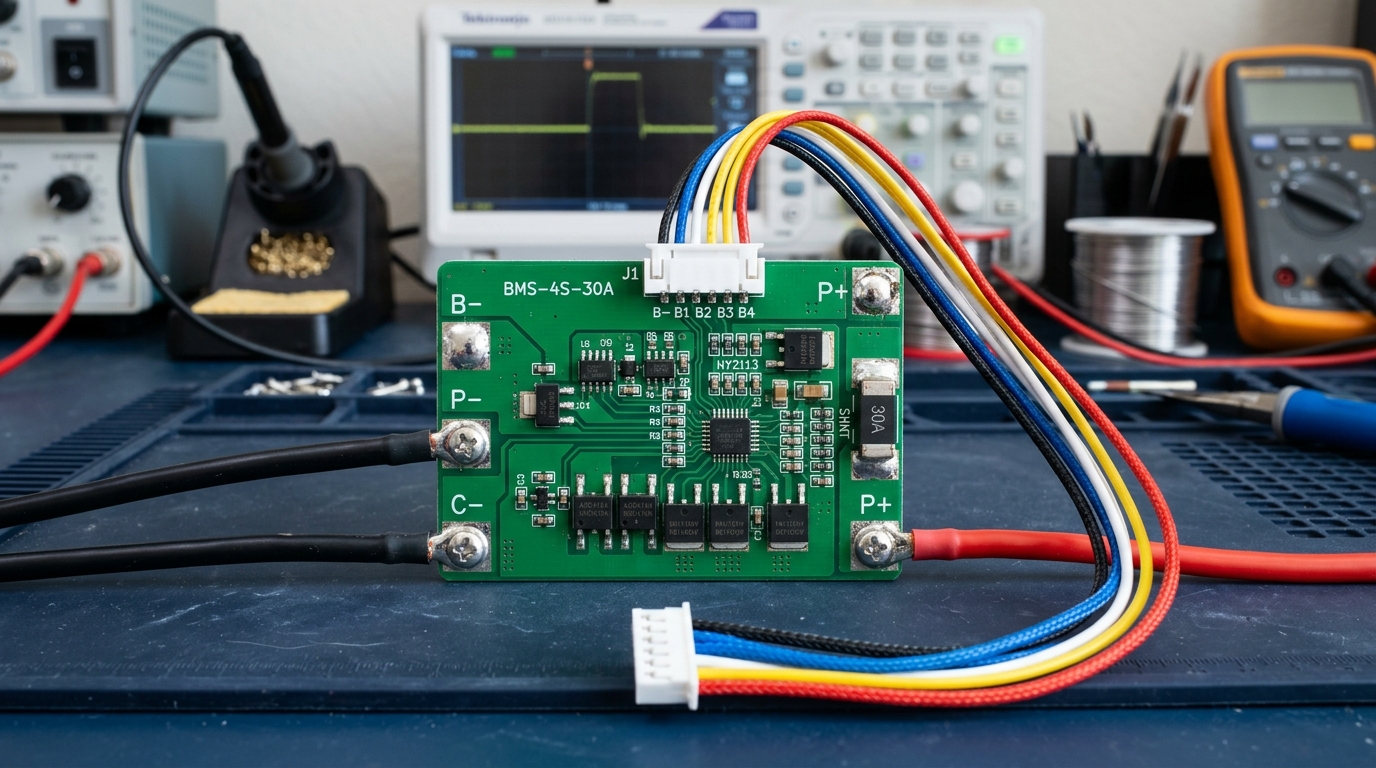
Core Engineering Takeaways
- •LiFePO4 (LFP) is the undisputed king of autonomous mobile robots (AMRs) in warehouses due to its extreme thermal stability ($> 270^\circ\text{C}$ thermal runaway onset) and 3,000+ cycle lifespan, despite lower gravimetric energy density than NMC.
- •Connecting a raw lithium pack directly to motor drive capacitors causes inrush currents exceeding 500 A that weld contactor terminals and blow fuses; a dedicated pre-charge circuit with power resistor is non-negotiable.
- •Coulomb counting suffers from unbounded open-loop integration drift; state-of-the-art BMS run an Extended Kalman Filter (EKF) combining current integration with an equivalent circuit model (Thevenin ECM) and Open Circuit Voltage (OCV) lookups.
- •Passive balancing bleeds excess charge as heat through SMD power resistors at 50–200 mA; active balancing transfers charge between cells using inductive/capacitive switches with > 85% energy efficiency.
- •In industrial fleets, BMS broadcast real-time cell voltages, current, pack temperature, and health metrics over CANopen or J1939 to embedded microcontrollers, publishing to ROS 2 sensor_msgs/BatteryState for autonomous dock scheduling.
- Basic DC circuit physics (Ohm's Law, Kirchhoff's Laws, Joule heating $I^2R$)
- Elementary chemistry of galvanic cells (anode, cathode, electrolyte, voltage potential)
- Microcontroller communications (I2C, SPI, CAN bus interfaces)
1. Industrial Cell Chemistries: LiFePO4 (LFP) vs NMC vs LTO
In consumer drones and quadrupeds where weight is the paramount constraint, Lithium Nickel Manganese Cobalt Oxide (NMC) cells dominate due to their superior gravimetric energy density ().
However, in commercial Autonomous Mobile Robots (AMRs), warehouse pallet jacks, and heavy service robots, Lithium Iron Phosphate (LiFePO4 / LFP) is the clear industry standard:
- Intrinsically Fire-Safe: LFP chemistry releases no oxygen during internal short circuits or mechanical puncture, eliminating violent thermal runaway fires.
- Superior Cycle Longevity: Delivers 3,000 to 5,000 full depth-of-discharge (DoD) cycles, translating to 5–8 years of continuous 24/7 warehouse operations with opportunity charging.
- Flat Discharge Curve Challenge: LFP maintains an extremely flat voltage profile between 20% and 80% SOC ( to per cell), making simple voltage-based battery gauges completely useless.
| Property | LiFePO4 (LFP) | Lithium NMC (18650/21700) | Lithium Titanate (LTO) |
|---|---|---|---|
| Nominal Voltage | 3.2 V / cell | 3.6 - 3.7 V / cell | 2.3 - 2.4 V / cell |
| Energy Density | 120 - 160 Wh/kg | 220 - 270 Wh/kg | 70 - 90 Wh/kg |
| Cycle Life (80% SOH) | 3,000 - 5,000 cycles | 600 - 1,200 cycles | 15,000 - 25,000 cycles |
| Thermal Runaway Onset | ~270 °C (Ultra-Safe) | ~210 °C (Requires active cooling) | > 300 °C (Extreme safety) |
| Fast Charge Capability | 1C - 2C (30 - 60 min) | 0.5C - 1C (60 - 90 min) | 6C - 10C (6 - 10 min) |
| Ideal Application | Warehouse AMRs, AGVs, Factory logistics | Drones, inspection quadrupeds, high-speed rovers | Heavy industrial buses, sub-zero mining robots |
2. BMS Hardware Architecture: AFE, High-Side MOSFETs & Pre-Charge
A modern Battery Management System (BMS) consists of four primary functional building blocks:
1. Analog Front-End (AFE) IC
Integrated circuits like Texas Instruments BQ76952 or Analog Devices LTC6813:
- Continuously measures individual cell voltages (up to 16S per chip) with millivolt accuracy ().
- Monitors pack current across a low-resistance current shunt resistor (e.g. ).
- Measures pack temperatures across multiple NTC thermistors glued to core cells.
2. Solid-State Protection Switching (High-Side vs Low-Side)
- High-Side Disconnect: Interrupts the positive battery rail (). Retains a continuous, unbroken system ground, preventing ground loop noise through chassis sensors and CAN transceivers. Highly recommended for robotics.
- Low-Side Disconnect: Breaks the battery ground (). Cheaper to drive with standard N-channel MOSFETs, but creates dangerous ground floating issues that can destroy USB and Ethernet ports connected to external chargers.
3. Pre-Charge Circuit Architecture
Motor controllers (VESC, Curtis, ODrive) contain massive DC link capacitor banks ( to ). Connecting a 48V battery directly results in an inrush surge:
A pre-charge branch engages a power resistor ( to ) for 150 ms to charge the bus to 95% before closing the primary high-current contactor.
Without an active pre-charge circuit, the massive capacitive inrush spark will weld relay contacts shut, blast micro-welds inside solid-state MOSFET dies, and trigger spurious instantaneous overcurrent cutoffs on the AFE.
3. State of Charge (SOC) & Health (SOH): Coulomb Counting vs EKF
Accurate State of Charge estimation is essential to prevent autonomous rovers from stranding in the middle of active warehouse transit aisles.
1. Coulomb Counting (Current Integration)
Integrates current over time:
- Flaws: Current sensor measurement offsets cause drift over hours of operation. Temperature variations alter effective battery capacity.
2. Dual Extended Kalman Filter (Dual-EKF)
Combines Coulomb Counting with an Equivalent Circuit Model (Thevenin ECM) consisting of an Open Circuit Voltage source , internal ohmic resistance , and parallel RC networks () modeling electrochemical polarization dynamics:
- The Kalman filter continuously estimates the true internal state by correcting model voltage predictions against real-time measured terminal voltage .
- Operates with SOC error even under rapid stop-and-go motor acceleration spikes.
Thevenin Equivalent Circuit Terminal Voltage Equation
At 100A pulse on a 48V pack with R_0 = 15 mΩ, terminal voltage dips instantaneously by 1.5V before recovering via R1-C1 relaxation dynamics.
4. Cell Balancing Strategies: Passive Shunt vs Active Switched Inductor
A multi-cell battery pack is only as strong as its weakest cell. During charging, manufacturing tolerances and temperature gradients cause individual cells to reach full charge at different times.
Without balancing, the BMS must stop charging the entire pack as soon as the first cell hits (for LFP), leaving other cells undercharged and permanently reducing usable pack capacity.
1. Passive Balancing (Resistive Bleed)
- Individual MOSFET switches connect a small power resistor ( to ) across cells with voltages above the pack average.
- Excess energy is dissipated purely as waste heat at to .
- Pros: Compact, inexpensive, highly reliable.
- Cons: Slow balancing times; generated heat warms up the pack.
2. Active Balancing (Bidirectional Energy Shuttling)
- Utilizes switched flyback transformers or capacitive charge pumps.
- Actively transfers charge from the highest voltage cell to the lowest voltage cell with efficiency.
- Balancing currents reach to , reducing balancing time by up to 10x without dissipating localized heat.
Always configure passive balancing to trigger only during the final Constant-Voltage (CV) charging phase when cell voltage exceeds the knee curve threshold (e.g., > 3.45 V for LFP). Balancing during the flat 3.2–3.3V plateau leads to false balancing due to subtle IR drops.
5. Heat Generation Physics & Thermal Runaway Mitigation
Heat generation in a lithium-ion battery during high-power robot acceleration consists of two distinct physical phenomena:
Where:
- is irreversible Joule heating caused by electron transport through tabs, foils, and electrolyte ionic resistance.
- is reversible entropic heating caused by electrochemical lattice expansion/contraction during intercalation.
The Thermal Runaway Cascade (NMC / Cobalt Cells)
- 1: Solid Electrolyte Interphase (SEI) layer begins decomposing, generating exothermic gas.
- 2: Polyolefin separator melts, inducing micro internal short circuits.
- 3: Cathode material breaks down, releasing pure oxygen into flammable liquid solvent vapors, triggering rapid combustion ().
Mitigation in Robot Packs:
- Maintain cell-to-cell thermal insulation using aerogel sheets or intumescent fire barriers.
- Integrate one NTC temperature sensor per every 4 cells.
- Program an emergency latching cutoff when any temperature reading exceeds .
Joule Heat Dissipation Equation in High-Current Packs
A 16S4P pack drawing 80A with total internal resistance 35 mΩ generates P = 80² × 0.035 = 224 Watts of heat inside the battery box, requiring active chassis heat sinking.
6. Telemetry & ROS 2 Integration: CAN Bus to sensor_msgs/BatteryState
In an industrial AMR running ROS 2, the BMS communicates with the main robot computer over an isolated CAN bus (Controller Area Network) at 250 kbps or 500 kbps using standard CANopen or J1939 protocols.
A dedicated micro-ROS driver or C++ node parses CAN frames and publishes standard sensor_msgs/msg/BatteryState messages:
#include <rclcpp/rclcpp.hpp>
#include <sensor_msgs/msg/battery_state.hpp>
#include <linux/can.h>
#include <linux/can/raw.h>

class BmsTelemetryNode : public rclcpp::Node {
public:
  BmsTelemetryNode() : Node("bms_telemetry_node") {
    battery_pub_ = this->create_publisher<sensor_msgs::msg/BatteryState>(
      "/robot/battery_state", 10);
    timer_ = this->create_wall_timer(
      std::chrono::milliseconds(200),
      std::bind(&BmsTelemetryNode::publish_battery_state, this));
  }

private:
  void publish_battery_state() {
    auto msg = sensor_msgs::msg::BatteryState();
    msg.header.stamp = this->now();
    msg.header.frame_id = "base_link";

    // Battery Specs (16S LiFePO4 Pack)
    msg.voltage = 51.2;             // 16 cells * 3.2V nominal
    msg.current = -14.5;            // Negative for discharge in ROS 2 standard
    msg.charge = 45.2;              // Remaining Ah
    msg.capacity = 50.0;            // Full rated capacity in Ah
    msg.design_capacity = 50.0;
    msg.percentage = 0.904;         // 90.4% State of Charge (0.0 to 1.0)

    msg.power_supply_status = sensor_msgs::msg::BatteryState::POWER_SUPPLY_STATUS_DISCHARGING;
    msg.power_supply_health = sensor_msgs::msg::BatteryState::POWER_SUPPLY_HEALTH_GOOD;
    msg.power_supply_technology = sensor_msgs::msg::BatteryState::POWER_SUPPLY_TECHNOLOGY_LIFE;
    msg.present = true;

    // Per-Cell Voltages (16 individual monitoring taps)
    msg.cell_voltage = {
      3.205, 3.201, 3.208, 3.204, 3.200, 3.202, 3.206, 3.203,
      3.204, 3.200, 3.205, 3.207, 3.201, 3.203, 3.202, 3.205
    };
    msg.cell_temperature = {28.5, 29.1, 28.8, 29.4}; // 4 NTC sensors

    battery_pub_->publish(msg);
  }

  rclcpp::Publisher<sensor_msgs::msg/BatteryState>::SharedPtr battery_pub_;
  rclcpp::TimerBase::SharedPtr timer_;
};
Note: ROS 2 C++ node receiving CAN frames from BMS and publishing standard sensor_msgs/BatteryState.
Common Questions & Troubleshooting
Q:Why does my robot battery gauge show 100% and then suddenly drop to 20% in 5 minutes?
This is the classic signature of relying on simple voltage measurement for LiFePO4 (LFP) cells. LFP has an extremely flat discharge curve (~3.2V per cell from 80% down to 20% SOC). Once the cell exits the plateau below 20%, voltage plunges off a cliff. Industrial robots must use Coulomb Counting combined with an Extended Kalman Filter (EKF) to track true chemical capacity.
Q:Can I connect two lithium battery packs in parallel to double my robot runtime?
Only if both packs are equipped with ideal diode OR-ing controllers or are at identical voltages (< 0.1V difference) before connection. If you connect a fully charged 54V pack in parallel with a depleted 44V pack, massive equalization currents (hundreds of amps) will rush between them, melting wires and tripping safety MOSFETs.
Q:What is the role of a solid-state pre-charge circuit in high-voltage robotics?
High-power motor drivers contain large electrolytic capacitors across their DC bus inputs. At the instant of power-up, discharged capacitors look like a dead short circuit. A pre-charge circuit routes power through a current-limiting resistor for 100–300 ms until capacitors reach ~95% voltage, preventing contactor welding and voltage spikes.
Q:Why is High-Side MOSFET switching preferred over Low-Side switching in robots?
Low-Side switching breaks the ground connection between battery and electronics. When the ground floats, sensors, cameras, and microcontrollers can back-feed current through grounded shielded communication cables (like USB, Ethernet, or CAN), permanently destroying delicate transceivers. High-Side switching keeps system chassis ground continuous at all times.